

Engagement vs Account Engagement
B2C scale and channel breadth vs B2B lead management close to sales. How to choose.

Both products send email and automate marketing, but they were built for different jobs. The right choice depends on your buying cycle, data volume and how closely marketing must work with sales.
Account Engagement was previously called Pardot, and you will still see that name in older documentation, field names and community posts.
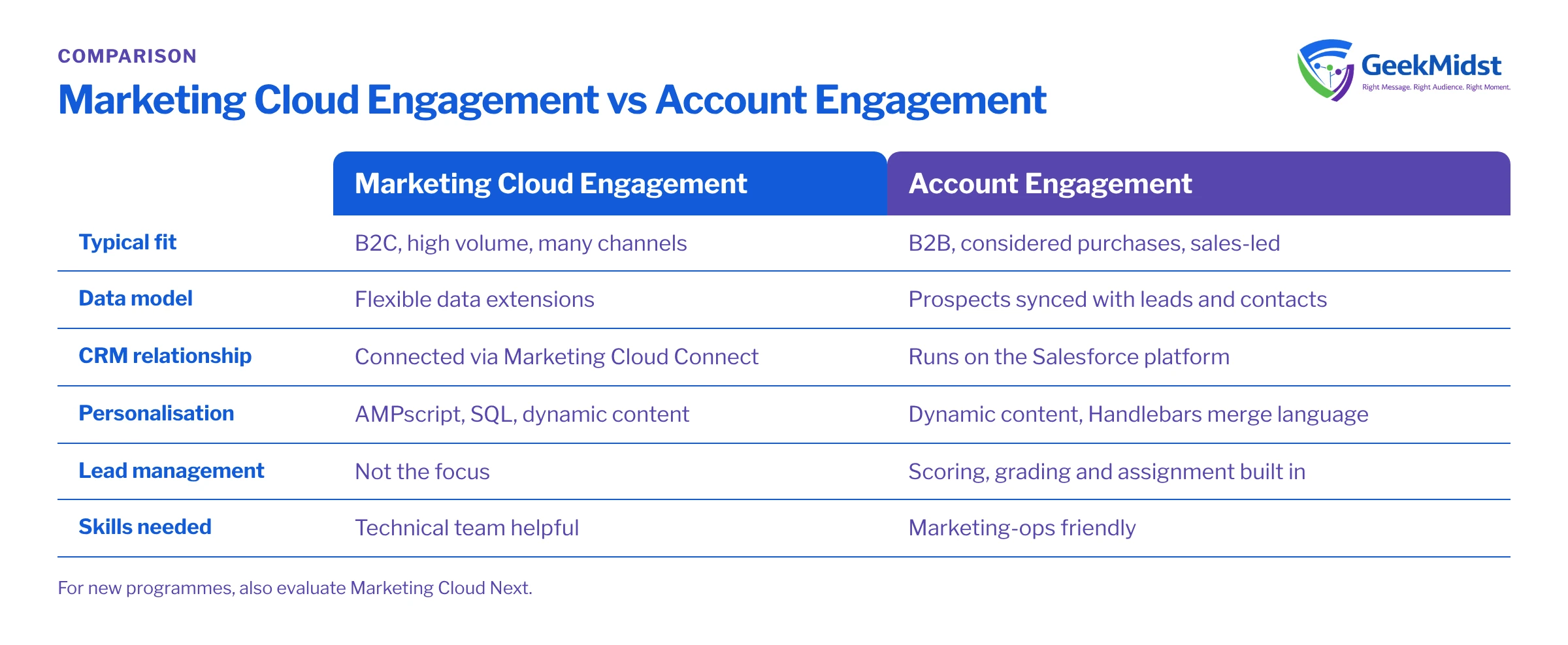
Side by side
| Marketing Cloud Engagement | Account Engagement | |
|---|---|---|
| Typical fit | B2C, high volume, many channels | B2B, considered purchases, sales-led |
| Data model | Flexible data extensions | Prospects synced with leads and contacts |
| CRM relationship | Connected via Marketing Cloud Connect | Lightning app; prospects sync through the Salesforce connector |
| Personalisation | AMPscript, SQL, dynamic content | Dynamic content, Handlebars merge language |
| Lead management | Not the focus | Scoring, grading and assignment built in |
| Skills needed | Technical team helpful | Marketing-ops friendly |
Choose Marketing Cloud Engagement when
- You send to large consumer audiences across email, mobile and advertising.
- You need complex segmentation and data processing.
- You run many journeys across channels at once, with personalisation driven by your own data model.
- Your team (or partner) is comfortable with SQL and AMPscript.
Choose Account Engagement when
- Sales teams work leads in Salesforce and need marketing context.
- Lead scoring, grading and nurture programmes are central.
- Marketing needs to hand qualified prospects to sales and report on pipeline influence.
- You want marketing operations to run day to day without a developer.
Questions to answer before you decide
- Who is the customer? Individuals buying for themselves point towards Engagement; buying groups inside companies point towards Account Engagement.
- How long is the buying cycle? Days or weeks with frequent purchases suits Engagement. Months with several decision makers suits Account Engagement.
- Where does the data live? If most of what you personalise on is in Sales Cloud leads, contacts and opportunities, Account Engagement keeps it close. If it comes from commerce, apps and other systems in volume, Engagement's data extensions are more flexible.
- Who will run it? Be honest about the skills you have. A capable tool that nobody on the team can maintain becomes shelfware.
- Which channels matter? Count the channels you actually plan to use in the next year, not the ones you might use eventually.
Common mismatches
| Situation | What goes wrong | Better approach |
|---|---|---|
| B2B team buys Engagement for "power" | Lead handover to sales has to be built and maintained by hand | Start with Account Engagement, or plan the integration work explicitly |
| B2C brand uses Account Engagement for volume sends | Data model and channel options feel restrictive as programmes grow | Evaluate Engagement or Marketing Cloud Next |
| Organisation runs both without clear ownership | Duplicate sends, conflicting consent records | Define which product owns each audience and where consent is mastered |
Can you use both?
Yes. Some organisations with separate consumer and business audiences run both products. If you do, decide early which system is the source of truth for consent and unsubscribes, and how the two avoid emailing the same person with conflicting messages.
Edition and licensing details, including which features are included at each tier, change over time. Check current Salesforce documentation or your account executive rather than relying on older comparisons.
Consider Marketing Cloud Next
For new programmes, also evaluate Marketing Cloud Next, which runs marketing on the core platform. Capabilities and licensing vary — confirm current availability for your edition.
Still unsure? Ask us — we will tell you honestly which fits.


