

Marketing Cloud Next vs Engagement
Two Salesforce marketing products with similar names and very different foundations. Here is how to judge which fits your data, team and existing estate.

If you run Marketing Cloud Engagement today, or you are choosing a Salesforce marketing platform for the first time, you now face two products with similar names and quite different foundations. This guide explains how they differ, where each one fits, and how to plan if you expect to run both for a while.
Packaging and feature availability are changing quickly. Treat this page as a framework for the decision, and confirm current capabilities, editions and licensing with Salesforce before you commit.
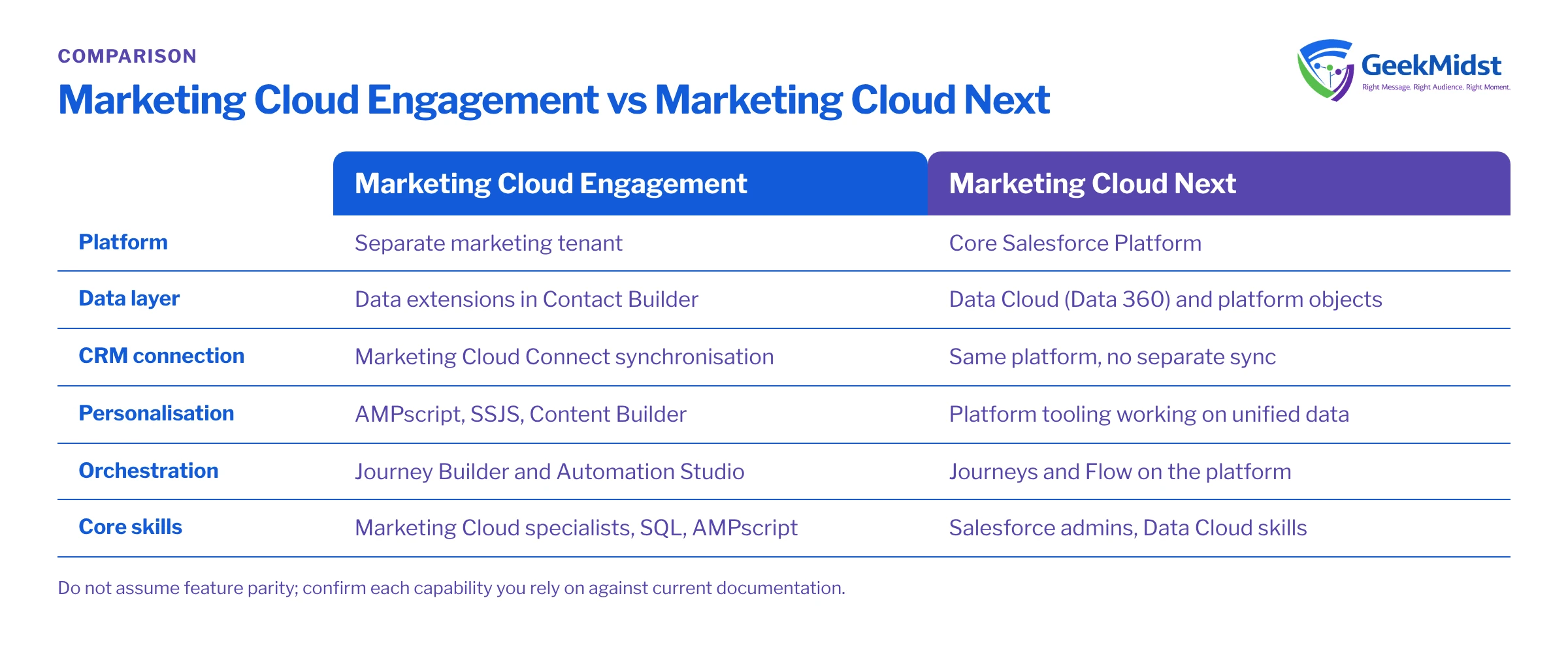
Two different foundations
Marketing Cloud Engagement is the established platform many teams simply call "Marketing Cloud": Email Studio, Mobile Studio, Journey Builder, Automation Studio, Contact Builder and CloudPages. It runs in its own tenant, separate from your Salesforce CRM org. Data lives in data extensions, personalisation is written in AMPscript or Server-Side JavaScript, and Marketing Cloud Connect synchronises CRM records into the marketing tenant.
Marketing Cloud Next is Salesforce's newer marketing product built directly on the core Salesforce Platform, with Data Cloud (now branded Data 360) as its data layer and Agentforce capabilities built in. Because it runs on the platform, marketing records, journeys, consent and reporting sit next to your CRM data rather than in a separate system. Administrators work with familiar platform tools such as permission sets, Flow and the standard security model.
That difference in foundation drives almost every trade-off on this page.
When Marketing Cloud Engagement fits
- You send high volumes across email, SMS and push and rely on sending infrastructure and deliverability settings you have already tuned.
- Your team has a large investment in AMPscript, SQL Query Activities and automations that work and are well understood.
- You depend on specific channels or features and have not yet confirmed that Marketing Cloud Next supports them in the way you need.
- Your customer data is not mastered in Salesforce CRM, and the marketing tenant is effectively your marketing database.
When Marketing Cloud Next fits
- Your customer, account and consent data already lives in Salesforce, and you want marketing to work from the same records without a sync layer in between.
- You licence, or plan to adopt, Data Cloud and want segments and profiles to come from one unified foundation.
- You are starting fresh, without a large estate of Engagement automations to rebuild.
- You want Salesforce administrators, rather than a separate team of Marketing Cloud specialists, to own most of the build.
- You want to use Agentforce for marketing work and accept that these capabilities are still evolving.
Side by side
| Marketing Cloud Engagement | Marketing Cloud Next | |
|---|---|---|
| Platform | Separate marketing tenant | Core Salesforce Platform |
| Data layer | Data extensions in Contact Builder | Data Cloud (Data 360) and platform objects |
| CRM connection | Marketing Cloud Connect synchronisation | Same platform, no separate sync |
| Personalisation | AMPscript, SSJS, Content Builder | Platform tooling working on unified data |
| Orchestration | Journey Builder and Automation Studio | Journeys and Flow on the platform |
| Core skills | Marketing Cloud specialists, SQL, AMPscript | Salesforce admins, Data Cloud skills |
| Maturity | Long established, large practitioner community | Newer, changing release by release |
| Natural starting point | Existing estate, high-volume B2C sending | CRM-centred teams and new builds |
Decision criteria that actually matter
- Where your source of truth lives. If customer and consent data is mastered in Salesforce CRM, Next removes a sync layer. If it is mastered elsewhere, both options need integration work.
- The size of your existing estate. Count journeys, automations, query activities, AMPscript content blocks and CloudPages. Each one is a rebuild decision, not a copy-and-paste.
- Data Cloud readiness. Next depends on Data Cloud, so inconsistent identifiers or scattered consent records become blockers. The Data Cloud readiness checklist is a good first pass.
- Team skills. An Engagement team strong in SQL and AMPscript will need time to learn platform data modelling, Data Cloud and Flow. A CRM admin team faces the reverse learning curve on Engagement.
- Licensing and consumption. Data Cloud is commonly sold on a consumption basis. Model expected volumes with your Salesforce account team rather than assuming costs will mirror Engagement.
- Timing. Contract renewal dates, peak trading periods and other programmes competing for the same people often decide the schedule more than technology does.
Running both: a phased coexistence plan
- 01
Inventory the Engagement estate
List every journey, automation, data extension, content asset and integration with an owner and a business purpose. Retire anything nobody can justify before you plan any move.
- 02
Group by programme, not by asset
Organise the inventory into lifecycle programmes such as welcome, abandoned cart, newsletter and service messages. Programmes move as a unit, with their data, content and reporting.
- 03
Prepare the data foundation
Bring sources into Data Cloud, map them to the data model, and set up identity resolution and consent before you build any journey on Next.
- 04
Pilot one contained programme
Choose something with clear measures and limited risk, such as a welcome series for one brand or region, and run it end to end.
- 05
Assign one owner per programme
A contact should never be in the same programme on both platforms. Agree which platform owns each programme and share suppression and consent between them.
- 06
Plan sender reputation carefully
Treat sender authentication, domains and volume ramp-up as a deliverability project with its own checks, not an afterthought.
- 07
Decommission deliberately
Switch off Engagement assets only after the replacement has run a full cycle and reporting has been reconciled.
Our view: it depends on where your data lives
There is no universal winner. If your organisation is CRM-centred, is investing in Data Cloud and does not carry a large Engagement estate, Marketing Cloud Next is worth evaluating seriously for new work. If you have a mature, high-volume Engagement setup that performs well, a rushed move adds risk without a clear return; improving what you have and piloting Next for one programme is usually the more sensible path.
Many organisations land somewhere in between, which is why a phased plan with clear ownership per programme matters more than the choice of a single platform. For the practical detail, read planning a move from Engagement to Next and the Marketing Cloud Next implementation checklist. Product documentation lives in Salesforce Help.
Questions we hear
Is Marketing Cloud Engagement being retired?
Can we move our AMPscript to Marketing Cloud Next?
Do we need Data Cloud for Marketing Cloud Next?
Can both platforms run at the same time?
How long does a move take?
Decide your Marketing Cloud direction
We can review your current Engagement estate and data foundation and help you decide what to move, what to keep and in what order. See also our Marketing Cloud Next implementation service.


