

Data Cloud vs a Traditional Data Warehouse
Data Cloud rarely replaces a warehouse. This guide explains what each is built for, where they overlap and how to make them work together without copying everything twice.

A common question when Data Cloud comes up: "We already have Snowflake (or BigQuery, Redshift, Databricks, or an on-premise SQL warehouse). Why would we need another data platform?" It is a fair question, and the honest answer is that the two are built for different jobs. They overlap at the edges, and most organisations that use Data Cloud well keep their warehouse.
What a data warehouse is built for
A warehouse is a general-purpose analytical store. Your data team designs the schema, loads data from every corner of the business and serves it to BI dashboards, finance reporting, forecasting and data science. It is excellent at history, breadth and complex SQL across large volumes.
What it is not built for is the last mile of customer engagement. Resolving many records into one person, keeping that profile current, building audiences that marketers can change themselves and pushing them into email, ads or CRM workflows all require additional tooling, such as reverse ETL services, custom identity logic and integration jobs.
What Data Cloud is built for
Data Cloud (now branded Data 360) is Salesforce's customer data platform, running on the Salesforce Platform. Data streams ingest source data into Data Lake Objects, which you map to Data Model Objects in the Customer 360 Data Model (see DLO vs DMO). Identity resolution builds unified profiles, calculated insights derive metrics, segments define audiences and activations deliver them to Marketing Cloud, advertising platforms and other targets.
Because it is part of the platform, unified profile data can also be used in Flow, on record pages and by Agentforce. That proximity to engagement and service workflows is its main advantage. It is not designed to be your finance reporting store or your data science sandbox.
How they compare
| Traditional data warehouse | Data Cloud | |
|---|---|---|
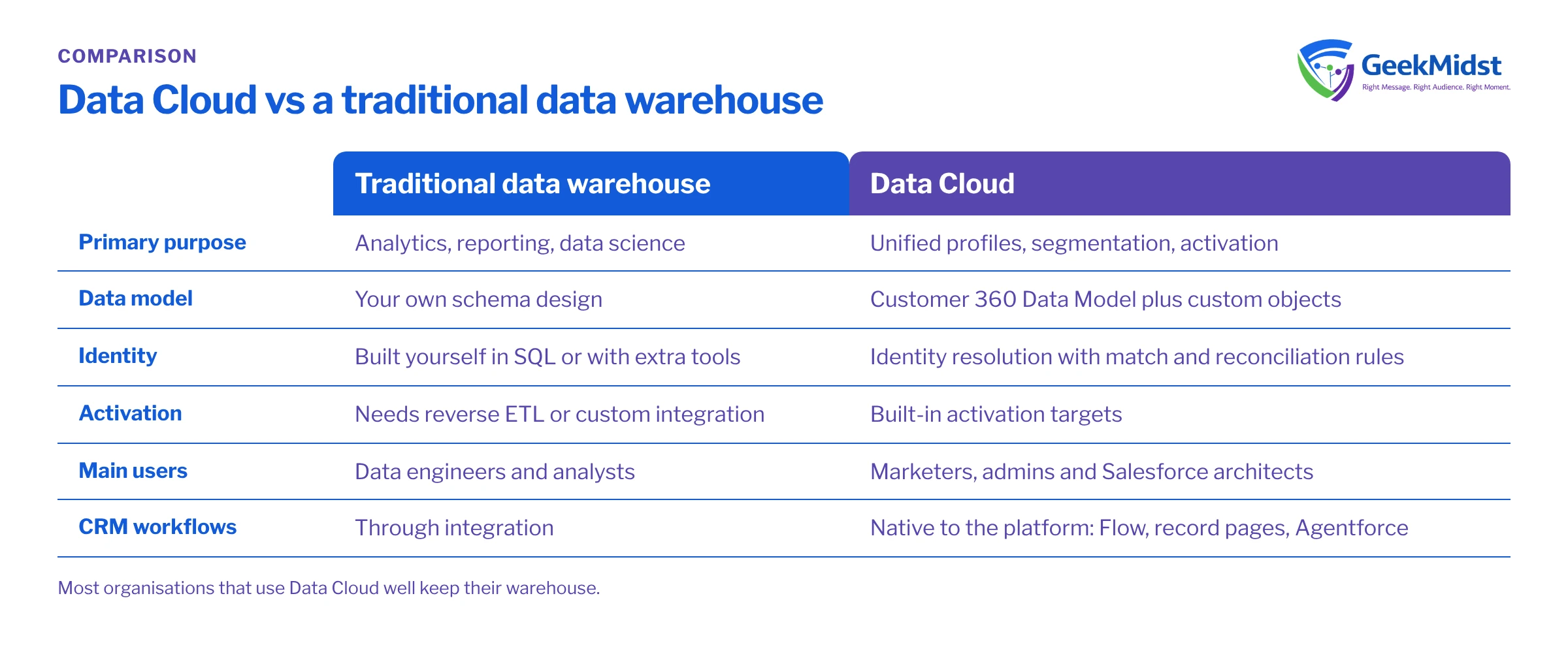
| Primary purpose | Analytics, reporting, data science | Unified profiles, segmentation, activation |
| Data model | Your own schema design | Customer 360 Data Model plus custom objects |
| Identity | Built yourself in SQL or with extra tools | Identity resolution with match and reconciliation rules |
| Activation | Needs reverse ETL or custom integration | Built-in activation targets |
| Main users | Data engineers and analysts | Marketers, admins and Salesforce architects |
| Use in CRM workflows | Through integration | Native to the platform |
| Cost model | Storage and compute from your vendor | Consumption based; check your contract |
| Core strength | Breadth and depth of history | Speed from data to engagement |
Using them together: zero copy
Data Cloud supports zero copy patterns with several major warehouse platforms, including Snowflake, Databricks, Google BigQuery and Amazon Redshift. Data federation lets Data Cloud query data where it already sits instead of copying it in, and data sharing lets the warehouse read Data Cloud data, such as unified profiles, without an export job. Supported platforms, directions and features change over time, so check the current list for your org in Salesforce Help.
Zero copy does not remove design work. You still decide which tables matter, how they map to the data model, how fresh they need to be and who pays for the queries. For the broader trade-off, see data virtualisation vs replication.
Decision criteria
- What question are you answering? "What was revenue by region last quarter?" belongs in the warehouse. "Which customers should receive this message today, and in which channel?" is a Data Cloud question.
- How fresh must the data be? Near-real-time triggers and journeys favour Data Cloud. Daily or monthly analysis is comfortable in a warehouse.
- Who will operate it? Data Cloud is usually run by Salesforce architects and admins with marketing input. A warehouse is run by data engineering. Both need an owner.
- Volume and consumption. Ingesting every raw event can be costly on a consumption model. Pre-aggregate where the full grain is not needed for segmentation.
- Governance. Decide where consent and preferences are mastered, and make sure both platforms honour the same values.
- Existing investment. A mature warehouse with clean customer tables is often the best single source to feed or federate into Data Cloud.
A practical coexistence pattern
- 01
Keep the warehouse as the analytical record
Finance, BI and data science continue to work from the warehouse. Data Cloud does not need to duplicate those models.
- 02
Agree the data Data Cloud needs
Start from use cases: the identifiers, consent, events and metrics each segment or journey actually uses.
- 03
Choose federation or ingestion per source
Federate large, slowly changing warehouse tables where supported. Ingest data that needs near-real-time processing or that does not exist in the warehouse.
- 04
Model and resolve identity in Data Cloud
Map to the data model, check data quality, then configure match and reconciliation rules for unified profiles.
- 05
Compute each metric in the right place
Heavy statistical models such as lifetime value scoring often run best in the warehouse with results shared in. Simpler rolling metrics suit calculated insights.
- 06
Share unified profiles back
Let analysts read unified profiles and segment membership so reporting and engagement use the same view of the customer.
Our view: it depends on the job
If your goal is analytics, a warehouse remains the right foundation and Data Cloud will not replace it. If your goal is acting on customer data inside Salesforce and Marketing Cloud, building that last mile on a warehouse alone means recreating much of what Data Cloud provides. For organisations doing both, the realistic answer is coexistence with a clear split of responsibilities. Our Data Cloud consulting work usually starts by drawing that line, and identity resolution is often the first design topic after it.
Questions we hear
Can Data Cloud replace our data warehouse?
Do we need a warehouse to use Data Cloud?
Should identity resolution happen in the warehouse or in Data Cloud?
Does zero copy mean zero cost?
What about data residency?
Draw the line between your platforms
Tell us about your warehouse and your engagement goals, and we will help you decide what belongs in Data Cloud and what should stay where it is.


