

CPQ to Revenue Cloud Advanced Migration Plan
A phased, illustrative plan for moving from Salesforce CPQ to Revenue Cloud Advanced without disrupting quoting, contracts or renewals.

This is an illustrative blueprint. It is a reference architecture, not a write-up of a specific client project; outcomes depend on your data and setup.
This blueprint sets out how we would plan a move from Salesforce CPQ to Revenue Cloud Advanced, the successor product within Revenue Cloud. Salesforce states that "Salesforce CPQ is end of sale, not end of life": existing customers can keep using it, add users and renew, and it receives support and critical fixes but no new features. No end-of-life date has been announced. That allows time to plan, but CPQ will not gain new capabilities.
Business problem
A sales organisation has run CPQ for years. Its product rules, price rules and custom scripts have grown until few people understand them, and quoting changes need a specialist. The business wants newer capabilities such as an attribute-based catalogue, agent-assisted quoting and a single model for quotes, contracts and billing, without disrupting live deals or renewals.
Revenue Cloud Advanced is a different product with its own data model, not an upgrade of CPQ. The migration is a re-implementation, and the plan must treat it as one.
Architecture
Current and target components
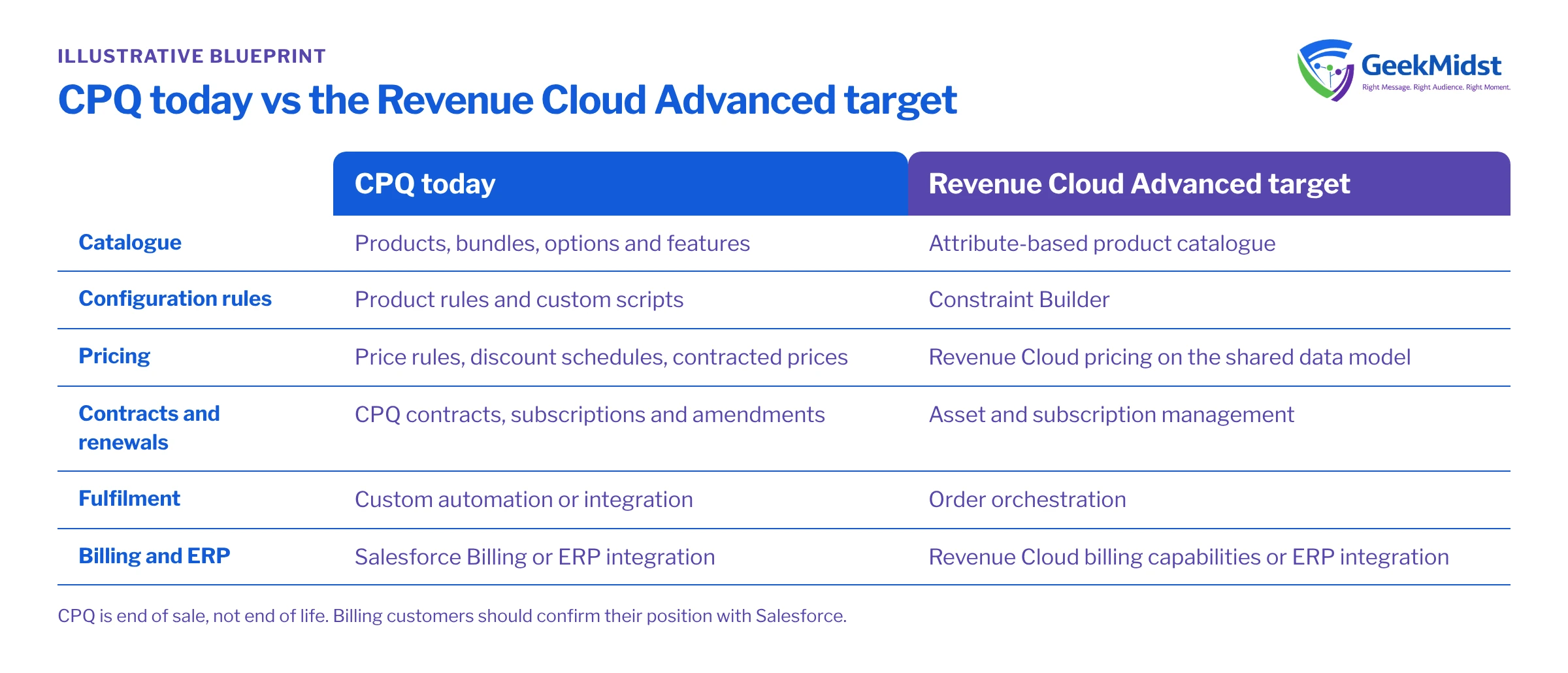
| Area | CPQ today | Revenue Cloud Advanced target |
|---|---|---|
| Catalogue | Products, bundles, options and features | Attribute-based product catalogue |
| Configuration rules | Product rules and custom scripts | Constraint Builder |
| Pricing | Price rules, discount schedules, contracted prices | Revenue Cloud pricing on the shared data model |
| Quotes and orders | CPQ managed-package quote objects | Revenue Cloud quote and order records |
| Contracts and renewals | CPQ contracts, subscriptions and amendments | Asset and subscription management |
| Fulfilment | Custom automation or integration | Order orchestration |
| Billing and ERP | Salesforce Billing or ERP integration | Revenue Cloud billing capabilities or ERP integration |
Salesforce describes Revenue Cloud as a single data model for pricing, quoting, contracts and billing, with asset and subscription management, order orchestration and Tableau Next dashboards. Winter '27 materials add support for up to 15,000 transaction lines per deal and agent enhancements for self-service, partner and renewal quoting. The CPQ status page does not cover Salesforce Billing, so billing customers should confirm their position with Salesforce. Integration with an ERP usually continues through middleware such as MuleSoft; see our order-to-cash integration blueprint.
Data model
The hardest part is mapping, not moving. CPQ bundles and options become catalogue products with attributes, and many product rules become constraints, but rarely one for one. We inventory every CPQ object in use, including custom fields and scripts, and classify each as migrate, redesign or retire.
Live commercial data needs the most care. Active contracts, subscriptions and assets must arrive in the target model so that renewals and amendments work from day one, with original start dates, terms and prices intact. Historical quotes are usually kept read-only in CPQ or archived rather than converted. Our data migration services and migration runbook template describe how we plan this.
Key components
Phase 1: Assess
Document quoting processes, rules, scripts, integrations and approvals, and identify which rules still reflect how the business sells. Agree success criteria and a cutover window that avoids quarter-end.
Phase 2: Redesign catalogue and pricing
Rebuild the catalogue with attributes, rewrite configuration logic in Constraint Builder and rebuild pricing. This is a chance to simplify; rules nobody can explain should not be migrated.
Phase 3: Build quoting, approvals and documents
Configure quote flows, approvals and documents, and rebuild ERP and e-signature integrations, often the longest task.
Phase 4: Migrate active contracts and assets
Run repeated trial migrations into a full sandbox, reconciling counts, values and renewal dates against CPQ after each run.
Phase 5: Cut over and decommission
Freeze CPQ changes, migrate final deltas, switch users, and keep CPQ read-only until the first renewal cycle has run cleanly.
Testing and launch
- 01
Create a pricing test pack
Collect real historic quotes, including complex bundles, with the expected price for each.
- 02
Compare prices side by side
Reprice every case in Revenue Cloud Advanced and resolve each difference with sales operations.
- 03
Test the full lifecycle
Test new business, amendments, renewals, cancellations and co-terming on migrated contracts, not just new quotes.
- 04
Rehearse the migration
Run at least two full trial migrations with reconciliation reports, refining the runbook each time.
- 05
Train by role
Train sellers, deal desk and finance separately on their own tasks.
- 06
Cut over with support
Go live outside quarter-end with extra support for the first weeks and a defined rollback point.
Risks and variations
- Like-for-like rebuilds carry old complexity into a new product; challenge each rule.
- Renewal breakage is the biggest commercial risk; test migrated contracts through a renewal before go-live.
- Hidden dependencies in reports, Flows, Apex and integrations reference CPQ objects; search for them early.
- Billing scope changes the plan significantly; decide early whether billing moves too.
- Staying on CPQ for now is a valid choice for some organisations, since it remains supported; plan the move around your roadmap.
Our Salesforce architecture consulting and implementation services can support assessment and delivery, and our testing and QA service covers pricing and lifecycle regression.
Sources
Planning a move off CPQ?
We can help you assess your CPQ setup, redesign catalogue and pricing, and plan a low-disruption migration.


