

B2B: Account Engagement or Marketing Cloud Next
Account Engagement is proven for B2B lead management. Marketing Cloud Next brings marketing onto Data Cloud. Here is how to decide which fits your B2B programme now.

B2B teams on Salesforce have relied on Account Engagement (formerly Pardot) for lead capture, scoring, grading and nurture for many years. Marketing Cloud Next now offers a different route: marketing built on the core platform with Data Cloud underneath. If you are renewing, starting fresh or feeling the limits of your current setup, you need a way to compare them that goes beyond product announcements.
Capabilities in Marketing Cloud Next are developing quickly, and packaging for B2B use cases may change. Use this guide to frame the questions, then confirm current features and licensing with Salesforce.
Where Account Engagement is strong
- Lead management built for B2B. Prospects, scoring based on engagement, grading based on fit, and assignment to sales.
- Engagement Studio for nurture programmes with branching on prospect behaviour and field values. See Engagement Studio design patterns.
- Forms, form handlers and landing pages that create and update prospects and sync them to Leads and Contacts.
- Connected campaigns and B2B reporting that tie marketing touches to Salesforce Campaigns and opportunities.
- Business units for separating brands or regions with their own prospect databases.
- A large pool of practitioners and well-understood implementation patterns.
Its limits show when you need data well beyond CRM and marketing engagement, for example product usage from a SaaS application, support history or data from several CRMs, combined into one profile and used for segmentation.
Where Marketing Cloud Next is strong
- Unified data through Data Cloud. Account, contact, product usage and other sources resolved into profiles that marketing, sales and service share.
- Native platform build. Marketing assets, journeys and consent live on the Salesforce Platform, using familiar admin tools and the platform security model.
- Agentforce capabilities for content, segmentation and other marketing tasks, which Salesforce continues to expand.
- One foundation for B2B and B2C where an organisation sells to both.
The open questions for a B2B team are the specific functions it relies on today. Confirm how scoring, grading, form handling, nurture branching and campaign attribution work in your edition before planning any move.
B2B needs mapped to each product
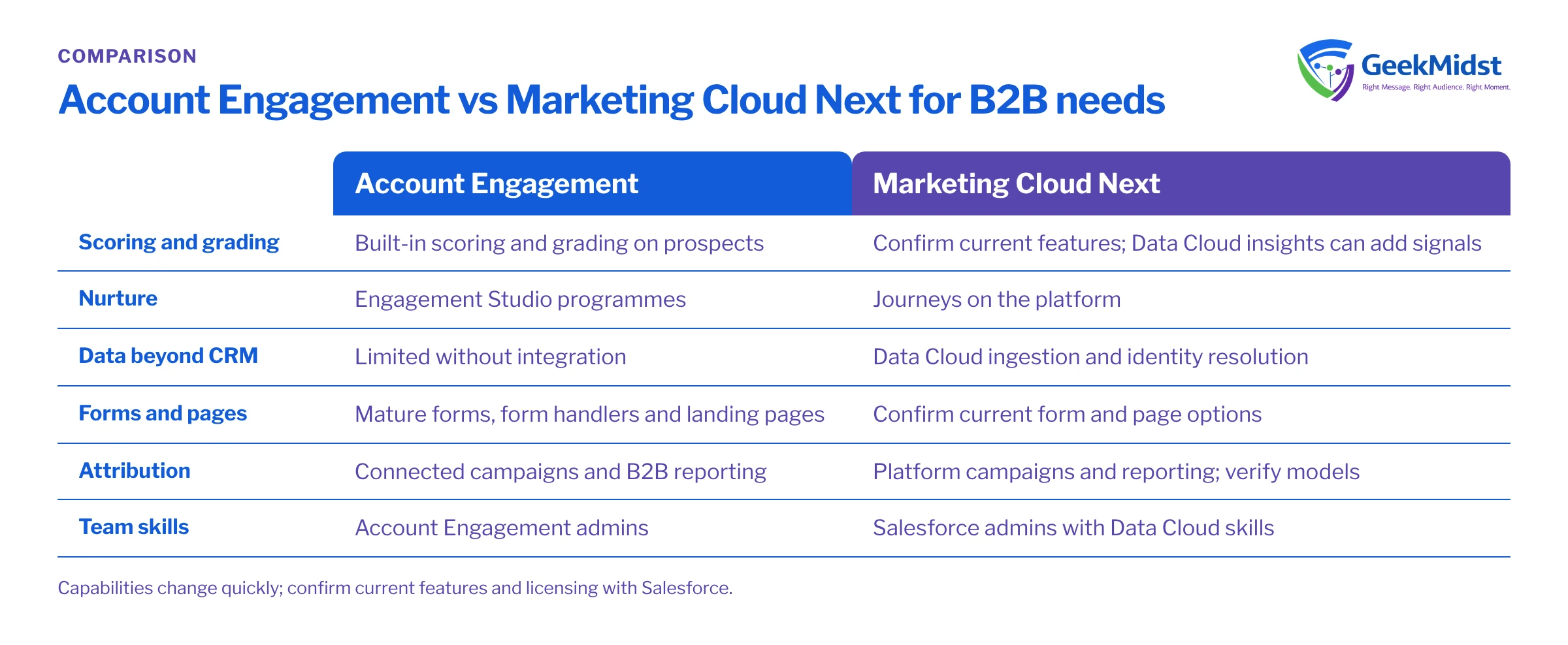
| B2B need | Account Engagement | Marketing Cloud Next |
|---|---|---|
| Lead scoring and grading | Built-in scoring and grading on prospects | Confirm current scoring features; Data Cloud insights can add signals |
| Nurture programmes | Engagement Studio | Journeys on the platform |
| Data beyond CRM | Limited without integration | Data Cloud ingestion and identity resolution |
| Forms and landing pages | Mature forms, form handlers and landing pages | Confirm current form and page options |
| Campaign attribution | Connected campaigns and B2B reporting | Platform campaigns and reporting; verify models |
| Sales alignment | Prospect activity and alerts in CRM | Shared platform records and profiles |
| Team skills | Account Engagement admins | Salesforce admins with Data Cloud skills |
Decision criteria
- Does your current setup work? If scoring is trusted, nurture runs and sales use the alerts, the bar for switching is high. Fixing gaps in Account Engagement is usually cheaper.
- Do you need data from outside CRM? SaaS companies wanting product usage in scoring, or groups with several systems of record, gain the most from Data Cloud.
- Are you already investing in Data Cloud? If it is being built for sales or service, marketing on the same foundation avoids yet another profile.
- How account-based is your marketing? Account-level scoring and buying-group views depend on joining contact and account data well. Assess how each option handles your specific model.
- What can your team support? Account Engagement admins and Data Cloud architects are different skill sets.
- What does history mean to you? Prospect activity history, scores and campaign influence need a migration or archiving decision.
Evaluating a move without disrupting pipeline
- 01
Document the current lead lifecycle
Write down how a prospect is captured, scored, graded, qualified and passed to sales, including thresholds and service levels agreed with sales.
- 02
Run a capability check
Compare each element of that lifecycle with current Marketing Cloud Next documentation and a hands-on demo, not a slide.
- 03
Assess the data foundation
Check identifier quality, account matching and consent records. Data Cloud amplifies data problems as readily as it solves them.
- 04
Pilot with one segment
Choose a region, product line or programme and run it on Next while the rest stays in Account Engagement, with clear suppression between them.
- 05
Agree success measures with sales
Use lead acceptance, conversion and speed to follow-up, compared against a baseline from the current process.
Our view: it depends on your data ambitions
If your B2B marketing is mainly CRM leads, forms and nurture, and it works, Account Engagement remains a sound choice and optimising it is likely the best use of budget. If you want marketing driven by unified data from several sources, are building on Data Cloud already, or market to both businesses and consumers, Marketing Cloud Next deserves a structured evaluation. In both cases, confirm the specific B2B functions you depend on. For the wider product picture, see Marketing Cloud Engagement vs Account Engagement and our scoring and grading setup service.
Questions we hear
Is Account Engagement being replaced by Marketing Cloud Next?
Can we run both at once?
Will we lose our scoring history if we move?
Do SaaS companies benefit more from Marketing Cloud Next?
Is Data Cloud required for B2B marketing on Next?
Choose your B2B marketing platform with confidence
We can document your current lead lifecycle, test it against both products and give you a clear recommendation with the risks spelled out.


