

Re-engagement and Win-back Programme
How to define inactivity, bring lapsed subscribers and customers back with a focused journey, and retire the ones who will not return, without hurting deliverability.

This is an illustrative blueprint. It is a reference architecture, not a write-up of a specific client project; outcomes depend on your data and setup.
Every list collects people who no longer open, click or buy. Sending to them costs money, drags down engagement signals that mailbox providers watch, and hides the real health of the programme. A re-engagement and win-back programme does two jobs: it brings back the people who can be brought back, and it stops mailing the ones who cannot.
This is a reference blueprint, not a write-up of a specific client project. Thresholds and timings are examples to calibrate against your own buying cycle.
The business problem
- "Inactive" is defined differently by marketing, CRM and finance, or not at all.
- Opens are used as the activity signal, but privacy features make many opens unreliable.
- Inactive subscribers stay on every send indefinitely, with no sunset rule.
- Discounts go to everyone who lapses, including people who would have come back anyway.
Segment definitions (example)
| Segment | Signal | Action |
|---|---|---|
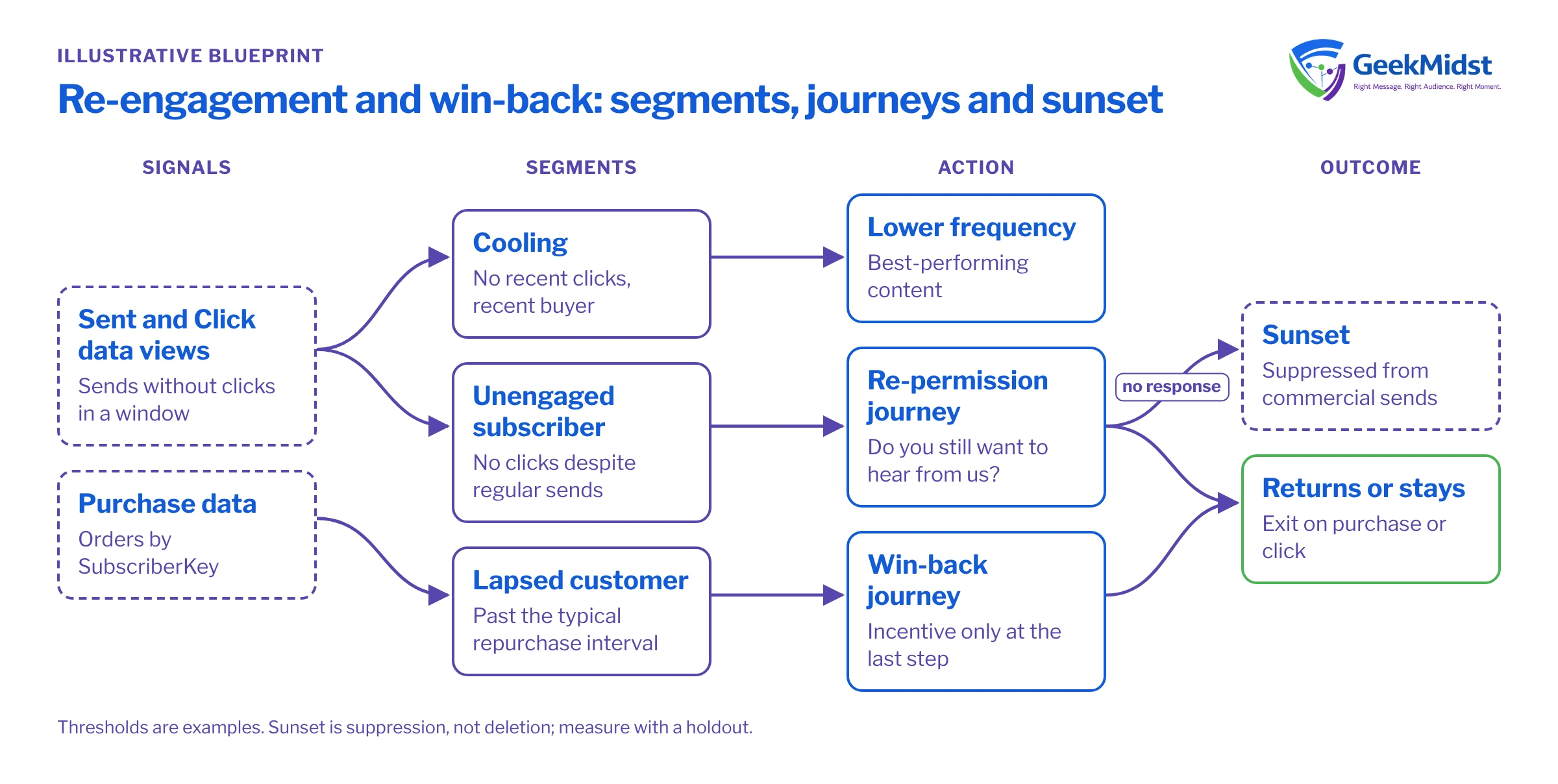
| Cooling | No clicks in 60 days, still receiving email, bought in the last 6 months | Lower frequency and switch to best-performing content |
| Lapsed customer | No purchase in 1.5 times the typical repurchase interval | Win-back journey with a reason to return |
| Unengaged subscriber | No clicks in 90 days despite regular sends, never or long since bought | Re-permission journey asking whether they want to stay |
| Sunset | No response to the re-permission journey | Suppress from commercial sends; keep service messages |
Journey design
Run two short journeys rather than one long one, because lapsed customers and unengaged subscribers need different messages.
Win-back journey (lapsed customers). Three emails over two to three weeks: a reminder of what they bought and what is new, a useful piece of content or service message, then an incentive only if they still have not returned. Exit on purchase. Keep the incentive for the last step and test whether it is needed at all.
Re-permission journey (unengaged subscribers). Two or three emails asking a direct question: do you still want to hear from us? Offer the preference centre so people can choose less email. Anyone who clicks stays; anyone who does not moves to the sunset segment at the end.
Send these from your normal sending domain and at a modest volume. A sudden large send to long-inactive addresses can itself cause bounces and complaints, so ramp up gradually. Our deliverability checklist lists what to watch.
Finding inactive subscribers with SQL
The query below uses the _Sent and _Click data views to find subscribers who received at least three emails in the last 90 days and clicked none of them.
SELECT
    s.SubscriberKey,
    COUNT(*) AS SendsLast90
FROM _Sent s
LEFT JOIN (
    SELECT DISTINCT SubscriberKey
    FROM _Click
    WHERE EventDate >= DATEADD(DAY, -90, GETDATE())
) c
    ON c.SubscriberKey = s.SubscriberKey
WHERE s.EventDate >= DATEADD(DAY, -90, GETDATE())
  AND c.SubscriberKey IS NULL
GROUP BY s.SubscriberKey
HAVING COUNT(*) >= 3Join the result with purchase data (for example, an Orders_DE keyed on SubscriberKey) to separate lapsed customers from subscribers who never bought, and exclude anyone who is already in an active service or onboarding journey.
Data model and consent
- Store segment membership with a date in a Lifecycle_Status_DE, so you can see when someone became unengaged and when they were sunset.
- Treat sunset as a suppression from commercial email, not deletion. Deletion is a separate decision under your retention policy; see contact deletion and data retention.
- People who choose "less email" in the re-permission journey should have that recorded as a preference, and audience queries must honour it.
- Do not use a win-back incentive to re-subscribe people who have opted out. Opted-out contacts are excluded from both journeys.
Testing and launch
- Run the segment queries and review samples by hand: are these people genuinely inactive, or is tracking missing for some sends?
- Check that recent purchasers and active service cases are excluded.
- Test both journeys in test mode, including the exit on purchase.
- Launch with a small slice of the segment and watch bounces, complaints and unsubscribes before increasing volume.
- Turn on the sunset suppression only after the first full re-permission cycle has finished.
How to measure it
Win-back is the area where holdouts matter most, because many lapsed customers return on their own.
- Hold back a random share of each segment from the journey and compare purchase or click rates over a fixed window.
- Report the incremental difference, not the raw number of people who bought after an email.
- Test the incentive separately: some contacts get the incentive email, some get the same journey without it.
- Track deliverability indicators for the whole programme before and after sunsetting, since removing unengaged addresses should be visible there over time.
Risks and variations
- Training customers to wait for discounts. Limit how often one person can receive a win-back incentive.
- Over-aggressive sunsetting of customers with long buying cycles. Set thresholds per product line where cycles differ.
- B2B variation. For accounts, inactivity at the person level may hide an active account. Check account activity before sunsetting.
We build programmes like this through Journey Builder consulting and Marketing Cloud SQL development.
Is your list carrying dead weight?
We can analyse engagement across your sends, propose inactivity definitions and build a win-back and sunset programme with a proper holdout.


