

Data 360 in 2026: What Has Changed
Data Cloud became Data 360 in October 2025. Here is what changed in 2026, what stayed the same and what teams should do next.

Data Cloud became Data 360 at Dreamforce 2025. Salesforce's FAQ is clear: "Salesforce Data 360 is the official new name for what was previously called Data Cloud." Unlike several other 2025 renames, this one stuck. The salesforce.com page title still reads "Data 360 (Formerly Data Cloud)". A new name doesn't change your data model, though. This article explains what changed during 2026, what stayed the same, and what teams running or planning Data 360 should do next.
What stayed the same
The core concepts are unchanged. If you built on Data Cloud, your work still applies:
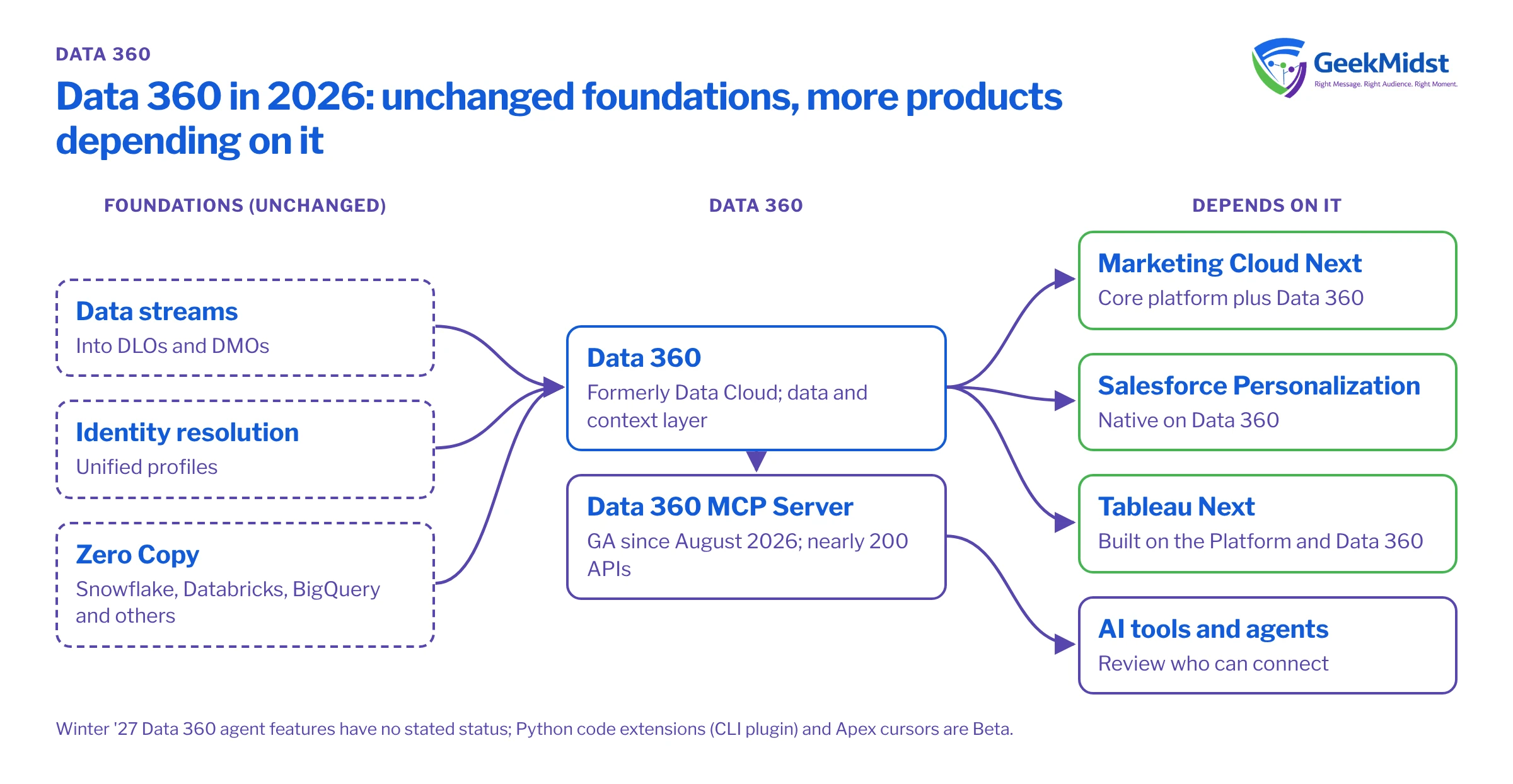
- Ingestion and modelling: data streams, data lake objects and data model objects. Our DLO vs DMO guide still describes the model accurately.
- Identity resolution and unified profiles. See how match rules work.
- Segmentation and activation.
- Zero Copy integration with Snowflake, Databricks, BigQuery and others.
Salesforce Help and older articles will use "Data Cloud" for some time. Treat the two names as the same product. Older names such as Salesforce Genie and Salesforce CDP are reported by third parties; only the Data Cloud name is confirmed by Salesforce as a former name.
What changed in 2026
Data 360 became the context layer for agents. Salesforce now describes Data 360 as a unified, real-time data and context layer for CRM, analytics and AI agents. The Agent Context Engine (ACE) is part of that positioning.
MCP access went GA. The Data 360 MCP Server has been GA since August 2026 as part of the Headless 360 expansion. It exposes nearly 200 Data 360 APIs to AI tools and agents. This is powerful, and it also means you need to review which users and tools can reach your data that way.
More products depend on it. Marketing Cloud Next runs on the core platform plus Data 360. Salesforce Personalization is native on Data 360. Tableau Next is built on the Salesforce Platform and Data 360. Data 360 Governance is listed alongside Salesforce Guardian. Choices you make in Data 360 now affect marketing, analytics and agents together.
Winter '27 additions
Data 360 in Winter '27
| Feature | What it does | Status |
|---|---|---|
| Agentic Segmentation and Activation | Conversational audience building, plus an Activation Agent | Not stated |
| Agent Memory | Shared memory across agents, governed by Data 360 policies | Not stated |
| Salesforce Catalog | A plain-language business-context catalogue | Not stated |
| Parent-child relationships for agent grounding | Including zero-copy DMOs from BigQuery, Databricks and Snowflake | Not stated |
| Python code extensions on zero-copy data | Custom code on federated data | CLI plugin Beta |
| Apex cursors for Data 360 DMOs | Process large DMO result sets in Apex | Beta |
Dreamforce 2026 also announced an expanded Data 360 and BigQuery Zero Copy integration, described as "GA Fall 2026". Check its status before you plan on it. In Spring '26, Salesforce noted that Agentic Setup and Data Management was slated for Summer '26 GA, so confirm where it stands if you were waiting for it.
What this means in practice
- Data quality matters more. When agents and personalisation read from unified profiles, duplicate or stale data shows up in front of customers. Our data quality checks apply before any agent work.
- Governance moves up the list. Agent Memory is governed by Data 360 policies, and the MCP server opens new access paths. Decide who owns data policies.
- Zero Copy is a design choice. Federated data avoids copies but brings query, cost and latency trade-offs. See our guide to data virtualisation vs replication.
- Consumption costs need watching. Salesforce doesn't publish a single price, and pricing and packaging are subject to change. Model your expected usage with your account team before you scale.
What to do next with Data 360
- 01
Update your vocabulary
Use Data 360 in new documents, with "formerly Data Cloud" once for readers who know the old name.
- 02
Audit your foundations
Review data streams, identity resolution rules and refresh schedules before adding agent features.
- 03
Review access paths
Decide who may use the Data 360 MCP Server and which tools can connect, and document it.
- 04
Pick one agent use case
Choose a single grounded use case, such as service case summaries, and test it before rolling features out widely.
- 05
Trial betas in a sandbox
Try Python code extensions and Apex cursors only in non-production orgs.
Questions we hear
Is Data 360 a different product from Data Cloud?
Do we need to rebuild anything because of the rename?
Are the Winter '27 Data 360 agent features GA?
Do we need Data 360 for Agentforce?
Related reading
Data Cloud readiness checklist
Check your foundations
→Monitoring Data Cloud jobs
Keep refreshes healthy
→Data 360 guide
What the product covers
→Salesforce Data Cloud consulting
How we help
→Sources
Getting Data 360 ready for agents?
We can review your Data 360 foundations, data quality and governance, and help you pick a first agent use case.


