

Personalization Engine vs Platform
A decisioning engine, a personalization platform and an implementation service solve different problems. Compare them, weigh build vs buy and see which fits.

Search for a "real-time personalization engine" and you will find three different things sold under similar words: a decisioning engine, a complete personalization platform, and an implementation service. They solve different problems, and mixing them up is how teams end up with software nobody can feed, or a project with no product behind it.
This guide compares the three, weighs build vs buy and helps you choose. For the basics, start with what real-time personalization is.
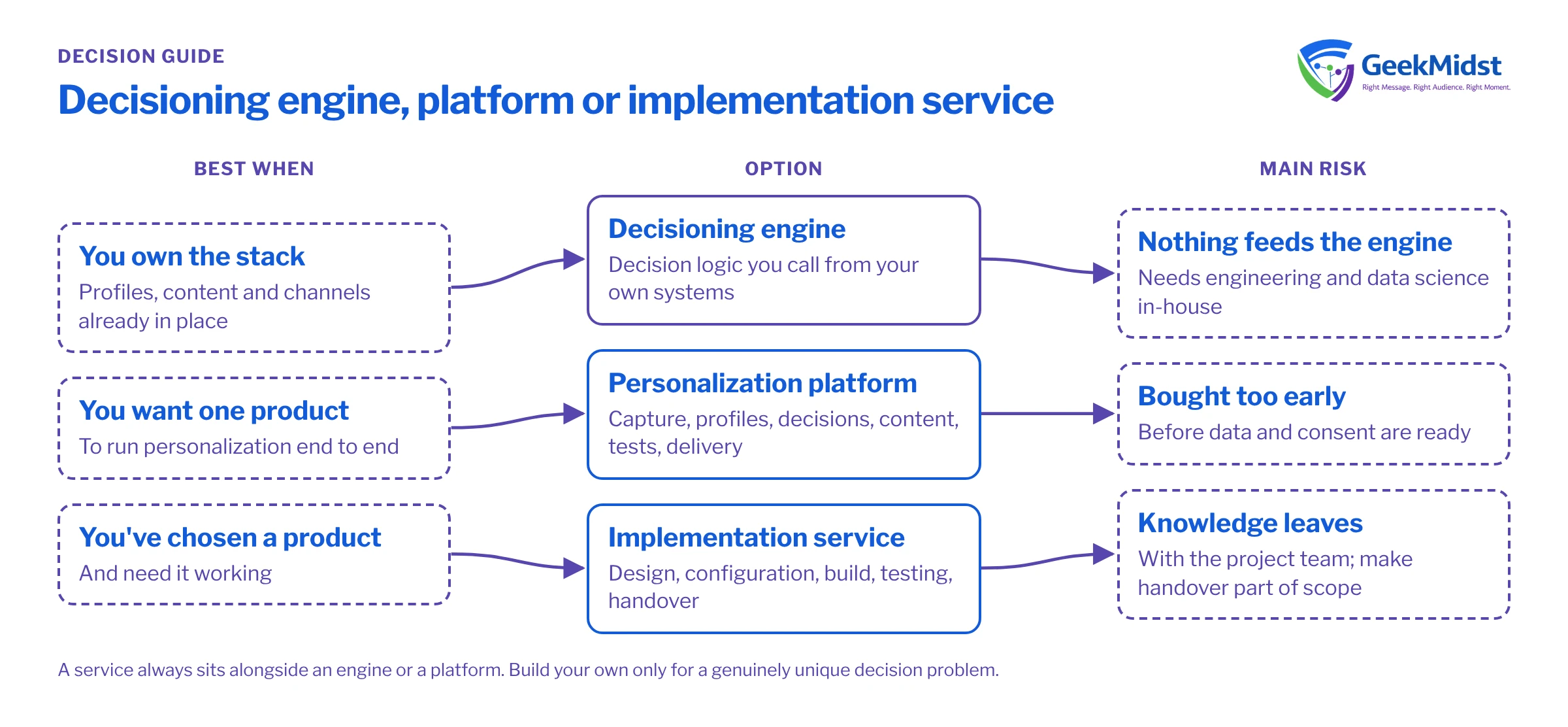
The three options
A decisioning engine
The engine is the part that chooses. Given a person, a context and a set of candidate items, it returns the best product, piece of content or offer. It might use rules, a trained model, or both. An engine on its own does not capture events, hold profiles, store content or render anything; you supply those.
Salesforce markets a "Real-time Personalization Engine" for Salesforce Personalization, and Marketing Cloud Personalization includes Einstein Decisions, next-best-offer decisioning using a "continuous-learning contextual bandit" algorithm, available in Premium Edition only.
A personalization platform
A platform wraps the engine with everything around it: event capture, profiles, catalog, content templates, experiments and delivery to channels. Salesforce's two products are examples:
- Salesforce Personalization is built natively on the Salesforce Platform and Data 360. It includes Agentforce Personalization Decisioning, web, mobile app and email personalization, product and content recommendations, and an allotment of personalization credits. Data 360 must be provisioned.
- Marketing Cloud Personalization (formerly Interaction Studio) is described by Salesforce as a "standalone, real-time interaction management platform". It uses a JavaScript beacon, a sitemap and an Event API, with campaigns built in its own UI.
An implementation service
This is people, not software. A service designs use cases, connects data, configures the product, builds templates, sets up experiments and hands over to your team. It always sits alongside one of the first two options.
Side-by-side comparison
Engine vs platform vs service
| Question | Decisioning engine | Personalization platform | Implementation service |
|---|---|---|---|
| What you get | Decision logic you call from your own systems | Capture, profiles, decisions, content, testing and delivery in one product | Design, configuration, build, testing and handover |
| Who handles data capture | You do | The platform, through its SDKs and connectors | The service sets it up on your chosen product |
| Who renders content | Your website, app or email tool | The platform or its connected channels | The service builds templates in your tools |
| In-house skills needed | Engineering and data science | Marketing operations and some front-end skills | A product owner and people to run it afterwards |
| Main risk | Engine is ready but nothing feeds it | Platform is bought before data and consent are ready | Knowledge leaves with the project team |
| Best when | You already own profiles, content and channels | You want one product to run personalization end to end | You have chosen a product and need it working |
Build vs buy
Building your own engine on a data warehouse can make sense when your decision problem is unusual and you have data scientists to maintain it. First, cost the parts that are easy to forget:
- Latency engineering. In-session decisions need event capture and a profile store fast enough to answer during the visit.
- Experimentation. Control groups, cohort assignment and analysis need building and maintaining.
- Consent enforcement. Every capture and every decision must respect the person's current choices.
- Model care. Models drift and catalogs change.
Buying moves most of that onto the vendor, in exchange for licence costs and the product's way of working. A middle path is to keep data in your warehouse and let the platform read it. Data 360 offers zero copy integration with Snowflake, Databricks, BigQuery and others, through query federation and other mechanisms. Salesforce's page labels file federation "In Beta Now", which may be out of date, so check Help. Our guide to data virtualisation vs replication covers the trade-offs.
Salesforce options, stated factually
- New customers. Salesforce calls Salesforce Personalization "the recommended path forward". It needs Profile and Item data graphs, a mapped catalog, and a Real-Time Profile Data Graph for objective-based recommenders.
- Existing Marketing Cloud Personalization customers. The Marketing Cloud Personalization+ SKU includes everything in Salesforce Personalization plus full Marketing Cloud Personalization functionality. Salesforce's FAQ says existing customers can get this "at no additional cost through the MCP+ SKU" on renewal or swap. Data 360 must be provisioned for both SKUs.
- Marketing Cloud Next customers. Salesforce Personalization is offered as an add-on for Growth and Advanced Edition customers.
- Running both. Salesforce states that "the Marketing Cloud Personalization and Data 360 web SDKs can be deployed side by side on the same site".
- Pricing basis. Per org per month, billed annually. We don't quote prices, and no public GA date for Salesforce Personalization was found.
We make no claims here about other vendors' products. Compare them on the same questions in the table above.
Which fits you
- Choose an engine if you already run your own profile store, content system and channels, with engineers to maintain the integration.
- Choose a platform if you want marketers to run personalization day to day, and you would rather not build capture, testing and delivery yourself. If you use Salesforce, check your Data 360 position first.
- Add an implementation service if your team has chosen a product but lacks the time or specialist skills to connect data, design decisions and set up experiments. Make knowledge transfer part of the scope.
- Consider building only when the decision problem is genuinely unique and you can fund the maintenance for years, not months.
The data and personalization readiness check helps you find gaps, and our real-time personalization blueprint shows how the pieces fit on Salesforce.
Questions we hear
Is Salesforce Personalization the same as Marketing Cloud Personalization?
Can an engine work without a platform?
Does buying a platform remove the need for implementation work?
Related reading
Salesforce personalization consulting
How we scope and deliver personalization on Salesforce
→Unified customer profile with Data 360
The profile foundation personalization relies on
→Personalization implementation guide
A longer planning guide for personalization projects
→Sources
Choose the right mix
We can review your data, channels and team, and recommend whether an engine, a platform, a service or a mix fits.


